


Every major AI model launch today sounds like a promise from the future.
Companies talk about breakthroughs, show polished demos, publish benchmark results, and explain how their new model can write better code, understand documents, analyze images, and solve difficult problems.
At this point, it is easy to get tired of big claims.
But Anthropic’s Claude Fable 5 is still worth paying attention to. Not because it is “another smart chatbot,” but because Anthropic is trying to show something more interesting: an AI system that is slowly moving beyond simple conversation and toward the role of a digital worker.
Not an assistant that only answers a question.
But a system that can be given a task — and then work toward the result for hours, days, or even longer.
That is where the story becomes interesting.
The Main Question: Can It Handle Real Work?
Demos almost always look impressive.
The model writes code quickly. It explains complex topics clearly. It analyzes a document. It builds a plan. It finds an error. It does things that, not long ago, seemed almost impossible.
But the real world is different.
In real companies, documents are incomplete. Requirements contradict each other. Code is old and messy. Spreadsheets are full of errors. Data is outdated. And people often do not fully know what they want until they see the first result.
So the main question about Claude Fable 5 is not: “How impressive does it look in a presentation?”
The real question is: can it be useful in actual work?
Because the real test for AI is not a perfect example from a launch video. The real test is the chaos of an ordinary workday.
Why Fable 5 May Matter
Until now, many large language models have worked in a fairly simple way: a person asks a question, the model answers, the person clarifies, the model corrects itself, and the human continues to manage the process.
In other words, the model may be very smart, but the human remains the real process manager.
Fable 5 is interesting because Anthropic is emphasizing a different approach. The model is supposed to do more than answer. It should be able to carry out long tasks: plan, use tools, check intermediate steps, work with documents, analyze images, keep the goal in mind, and return a finished result.
That is no longer just a chat.
That starts to look like a workflow.
Imagine that you do not ask AI: “Write me a piece of code.”
Instead, you say: “Here is the project. We need to move the old system to a new architecture, check the dependencies, avoid breaking the tests, and prepare the changes for review.”
That is a completely different level of difficulty.
And this is exactly where even very strong models usually begin to fail.
The Problem Is Not the First Step — It Is the Middle of the Journey
Many users have already noticed one thing about modern AI systems: they often start brilliantly.
The model creates a convincing plan. It explains its logic. It writes the first version. It feels like everything is under control.
But then comes the long middle of the task.
And that is where problems appear.
The model may forget an important constraint. It may misread a file. It may invent a dependency that does not exist. It may repeat an action it has already done. It may drift away from the task. It may beautifully explain a solution that does not actually work.
This is a very human problem: starting is easy, finishing is hard.
If Fable 5 is truly better at keeping a task on track over a long period of time, that may matter far more than another high benchmark score.
Because the real value of AI for business is not in the impressive first answer. It is in the boring middle of the work — where someone has to check, compare, correct, and keep the thread alive.
Businesses Do Not Need “Smart Answers.” They Need Reliable Execution.
Companies do not buy AI for beautiful sentences.
They need work to move faster, errors to be found earlier, documents to be analyzed more accurately, code to be written more safely, and employees to spend less time on routine tasks.
But there is an important catch.
If AI does the work quickly, but a human then has to spend a long time checking every small detail, the savings may disappear. Even worse, a new risk may appear: the model produces many convincing artifacts that are not always reliable.
That is why, for the corporate market, the key question is not simply “how smart is the model?”
The real question is: “how much can we trust it during the process?”
Can it work with messy input?
Can it admit that it does not have enough information?
Can it stop when it is unsure?
Can it show where its conclusion came from?
Can it avoid losing the legal, financial, or technical meaning of a document?
These are the questions that will shape the future of Fable 5 much more than any marketing phrase.
Long Context Is Not Magic
One of the major themes around new AI models is the ability to work with a large context. In simple terms, the model can “read” and take into account much more information at once: long documents, large codebases, file collections, spreadsheets, and reports.
That sounds powerful.
But large context alone does not guarantee anything.
If you give a model a million words, it does not automatically understand the meaning better. It may mix up document versions, refer to the wrong section, combine old and new data, or miss a small but important footnote.
In business, such details matter a lot.
One table may cancel out another. One paragraph in a contract may change the meaning of an entire deal. One comment in code may explain why the obvious solution should not be used.
So the value of Fable 5 will depend not on how much information it can “fit in its head,” but on how accurately it can work with that information.
Large context is useful only when the model preserves meaning.
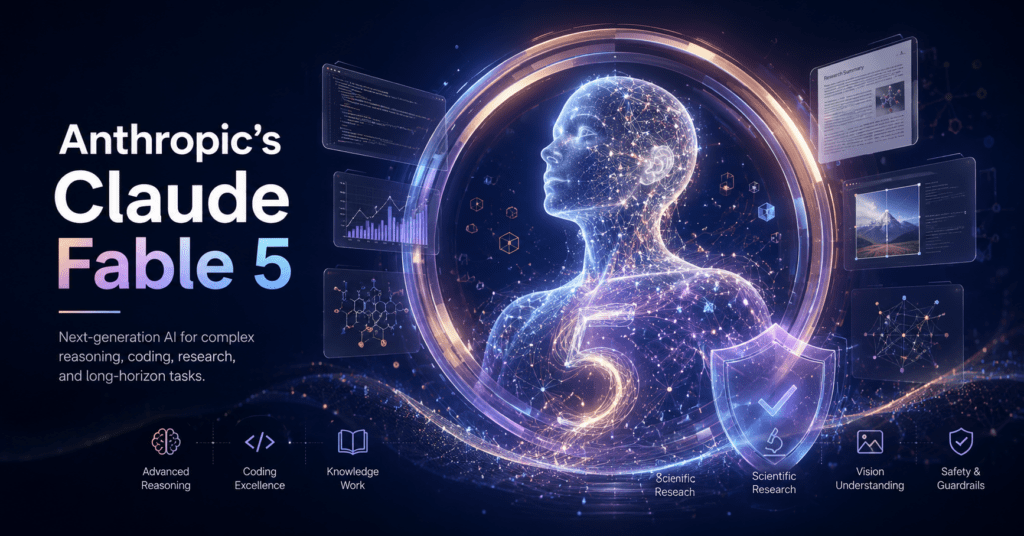
Visual Understanding May Matter More Than It Seems
Another important part of the story is working with visual materials.
In real life, company knowledge rarely exists in a clean text file. It is scattered across PDFs, presentations, screenshots, spreadsheets, diagrams, charts, scans, reports, and internal dashboards.
Many important decisions are made based on mixed materials: an image plus a table, a diagram plus comments, a screenshot plus financial data.
If Fable 5 is truly better at understanding such materials, it could open the door to serious use cases in finance, audit, consulting, law, engineering, medicine, and scientific research.
Because in these fields, text generation is not enough.
The model must be able to turn complex material into a clear and reliable structure.
But There Is Another Side: Security, Data, and Control
The more powerful a model becomes, the more questions appear around its use.
Where is the data stored?
Who can access it?
Can confidential documents be uploaded?
How long are prompts and files retained?
What happens if the model processes sensitive information?
For an ordinary user, this may sound boring. For a large company, these are critical questions.
Sometimes a model may be technically very strong, but a company still cannot quickly adopt it because of security requirements, legal risks, or data retention policies.
This is an important lesson for the entire AI market: the smartest model will not automatically win. The winner will be the model that can be safely, clearly, and legally integrated into real processes.
Why Anthropic Is Getting So Much Attention
Anthropic is now in a special position. The company is not just developing a model. It is building a big story about the future of knowledge work.
That story sounds something like this: AI will become not a separate tool, but a new layer of work infrastructure. It will write code, analyze documents, help researchers, speed up development, manage tasks, and perform complex chains of actions.
For investors, this is a very attractive narrative.
But this is exactly why big claims should be read carefully. When a company grows, raises major funding, and prepares for the public markets, it needs to show not just a product, but a large vision of the future.
That does not mean the technology is bad or exaggerated.
It means readers need to separate facts from narrative.
AI is developing quickly. But the market is learning to sell the future even faster.
Scientific Promises Need Verification
Claims about scientific breakthroughs deserve special caution.
If a model helps with protein design, genomic analysis, or drug development, that sounds incredible. And it may genuinely become very important.
But in science, a beautiful case study is not enough. Independent validation, reproducibility, expert review, and time are needed.
AI may speed up specific stages of scientific work. That alone is already significant. But there is a big distance between “helped with a task” and “changed the scientific process.”
So these claims are better viewed as early signals, not as final proof of a revolution.
What May Actually Change
The most interesting part of the Fable 5 story is not that another powerful model has appeared.
The more interesting point is that the market is gradually shifting from AI that talks to AI that does.
At first, we were impressed that models could write text. Then we were impressed that they could code. Then we saw that they could analyze images and documents. Now the next stage is models that can perform long tasks using tools.
This is no longer just generation.
This is execution.
And if this approach becomes reliable, it could change many professions.
Not necessarily by replacing people. More likely, by changing the structure of work itself. Humans may spend less time on routine tasks and more time setting goals, checking quality, making decisions, and assessing risks.
AI will not be a “magic button.”
It will become a working partner.
But only if it learns to be reliable.
Fable 5 Is a Breakthrough Candidate, Not a Proven Breakthrough
In my view, Claude Fable 5 should be understood this way for now: not as a finished revolution, but as a strong candidate for a breakthrough.
The difference matters.
A breakthrough is not a press release. It is not a demo. It is not one successful case.
A real breakthrough happens when many independent companies start getting stable value from the model in real tasks. When work takes less time. When the number of errors goes down. When results pass review. When people trust the model not because it speaks beautifully, but because it proves its reliability again and again.
Until that evidence exists at scale, the right position is not excitement and not skepticism for its own sake.
The right position is careful attention.
The Main Test Will Be Very Simple
In the end, the future of Fable 5 will not be decided by presentations or bold claims.
It will be decided by simple work questions.
Does it speed up real processes?
Does it avoid creating hidden risks?
Does it write code that experienced engineers are willing to accept?
Does it understand documents without losing meaning?
Can it work with visual materials accurately enough?
Can it keep a plan stable over a long period of time?
Does it know when to stop and call a human?
If the answers to these questions become positive across different companies and different types of work, then Anthropic will truly be able to talk about a breakthrough.
Until then, Claude Fable 5 is one of the most interesting signals of where frontier AI is heading.
We are moving from the era of AI that gives impressive answers to the era of AI that must learn to work reliably.
And that may be far more important than any beautiful demo.
thanks for info.