

Updated as of November 2, 2026.
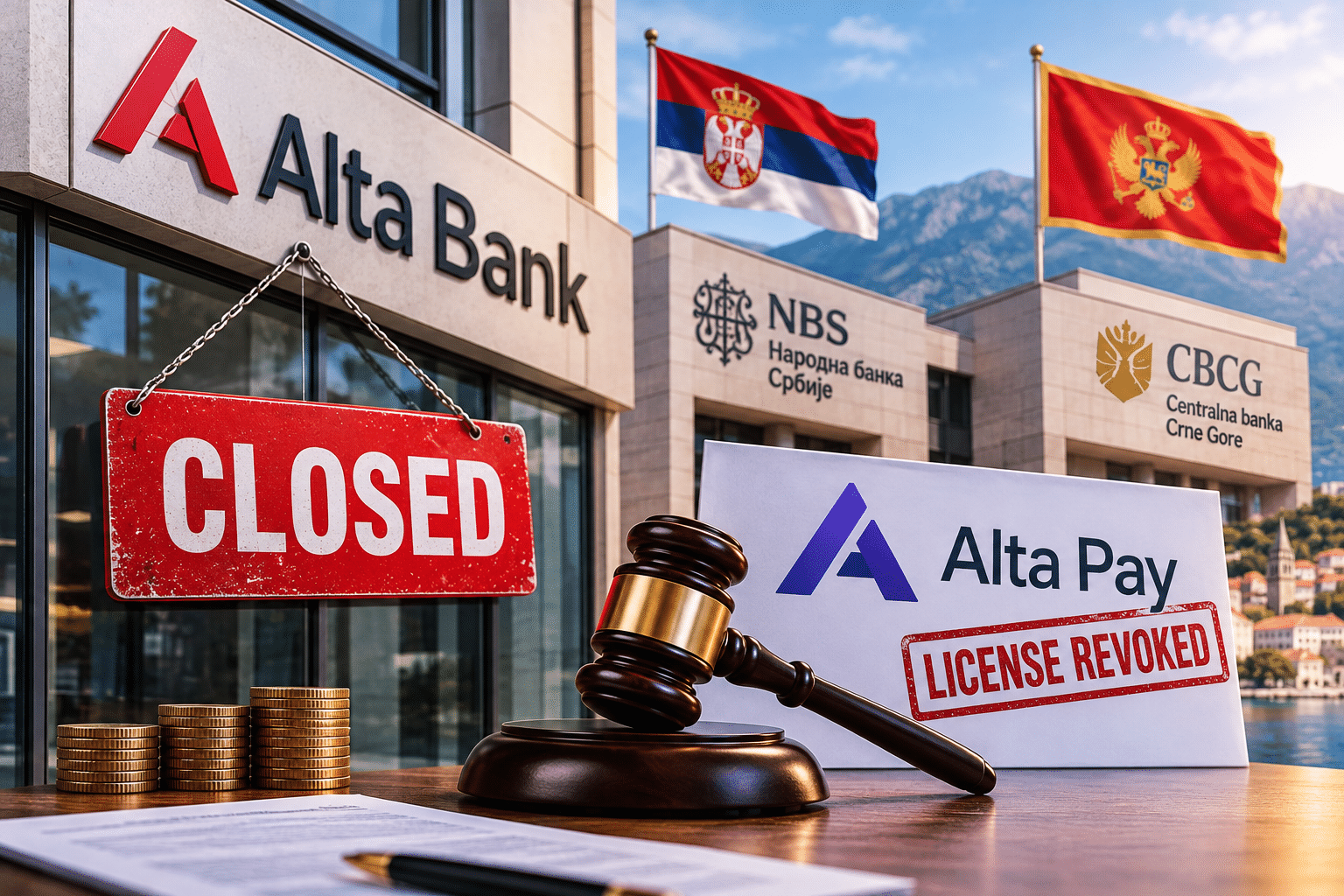
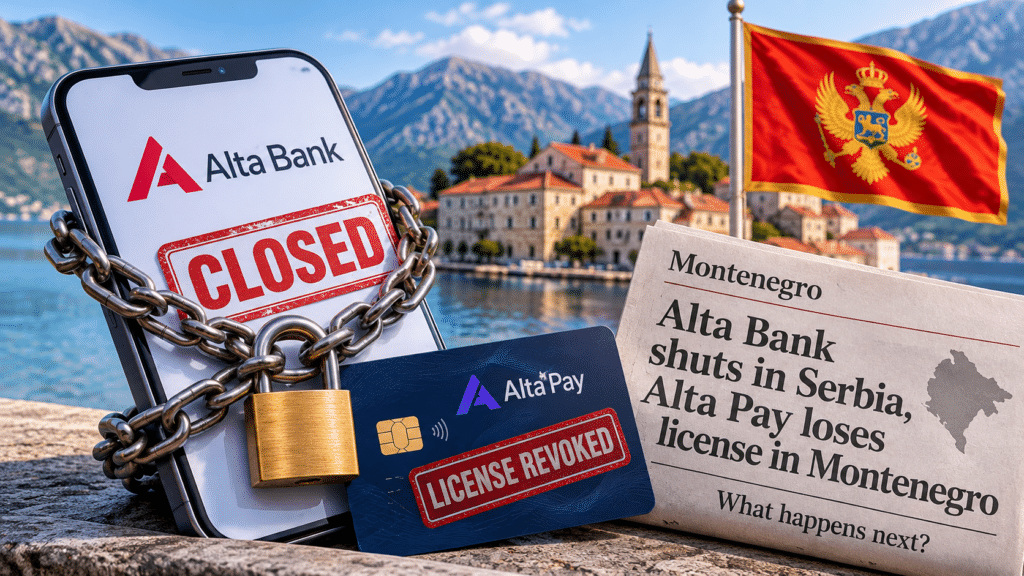
In late October and early November 2026, events unfolded around the Alta financial group, affecting several countries in the Balkan region. The National Bank of Serbia revoked the license of Alta Banka a.d. Beograd, and subsequently, the Central Bank of Montenegro (Centralna banka Crne Gore, CBCG) decided to revoke the payment services permit of the Montenegrin company Alta Pay Group DOO Podgorica.
These decisions raised questions among Montenegrin residents, entrepreneurs, foreign citizens, and users of international money transfers. Particular concern arises from the closely related names of Alta Bank and Alta Pay Group, and the consequences of the regulators’ decisions affect the activities of organizations under the same brand. However, there is a fundamental legal nuance in this story: Alta Banka was not a licensed bank in Montenegro. Another organization, Alta Pay Group DOO, operated in the country, which had the status of a payment institution rather than a bank.
The difference between these two organizations is directly relevant to understanding the situation, protecting client funds, and the subsequent consequences.
Let’s examine in detail what happened, the reasons for the decisions, the grounds cited by financial regulators, and what clients should be aware of.
-
What happened to Alta: a timeline of events
Events unfolded almost simultaneously in two countries—Serbia and Montenegro.
- October 30, 2026 – Decision of the National Bank of Serbia
The Executive Board of the National Bank of Serbia (Narodna banka Srbije, NBS) decided to revoke the banking license of ALTA Banka a.d. Beograd. The regulator explained the decision by citing a significant deterioration in the bank’s financial condition and the risks to depositors’ interests.
2. October 31, 2026 – Statement by the Central Bank of Montenegro
The Central Bank of Montenegro issued an official clarification: Alta Banka does not operate in Montenegro and does not have a banking license in the country. The regulator specifically noted the existence of Alta Pay Group DOO Podgorica, which provided payment and money transfer services.
- November 1, 2026 – Revocation of Alta Pay Group’s authorization
The Council of the Central Bank of Montenegro decided to revoke the authorization to provide payment services from Alta Pay Group DOO Podgorica. The basis for this decision was the determination that the company no longer meets the statutory conditions for such activities.
- November 2, 2026 – Situation after the regulators’ decisions
As of this date, both decisions have been officially confirmed by the respective central banks. The Central Bank of Montenegro states that Montenegro’s financial system remains stable, and the country’s payment infrastructure continues to operate as usual.
-
Why was Alta Banka closed in Serbia?
The first event that triggered the chain of decisions was the revocation of ALTA Banka a.d. Beograd’s banking license. On October 30, 2026, the National Bank of Serbia officially announced the decision. In its statement, the regulator cited a significant deterioration in the bank’s financial situation.
What reasons did the Serbian regulator cite?
According to the official NBS statement, control measures aimed at increasing the bank’s liquidity were conducted prior to the license revocation.
During the supervisory measures, the regulator established the following circumstances:
- The bank’s financial position had significantly deteriorated over the previous period.
- There was a likelihood of further deterioration in its financial situation.
- The risk of further deterioration in liquidity remained.
- The interests of depositors were threatened.
It was these latter circumstances that led to the most serious measure—license revocation.
It is important to understand that a bank’s liquidity and its profitability are different indicators. A bank may have assets, real estate, a loan portfolio, and other financial instruments, yet still experience difficulties fulfilling its obligations to clients when required. For example, if a large number of depositors simultaneously demand repayment, the bank must have sufficient liquidity to meet these demands. If the ability to meet obligations on time is compromised, this creates a risk for depositors. The National Bank of Serbia has identified this very threat.
What will happen to Alta Banka depositors?
The official NBS statement also stated that the Deposit Insurance Agency of Serbia (Agencija za osiguranje depozita) will be appointed by the court as the bankruptcy trustee. The regulator stated that the Agency must ensure the payment of insured amounts and the ability to dispose of depositors’ funds within seven business days in accordance with deposit insurance legislation. This means that after the license is revoked, further proceedings will shift to the statutory insolvency resolution regime. It is important not to confuse deposit insurance in Serbia with the protection of Alta Pay clients’ funds in Montenegro. These are different legal entities, different types of activities and different regulatory mechanisms.
-
Did Alta Bank operate in Montenegro?
This is one of the most important questions of the entire story.
On October 31, 2026, the Central Bank of Montenegro issued a special statement explicitly clarifying the legal status of Alta Bank.
The regulator stated:
- Alta Banka does not conduct banking activities in Montenegro.
- It does not have a CBCG banking license.
- Alta Banka’s activities are exclusively related to Serbia and North Macedonia.
This means that the statement about the closure of Alta Bank’s Montenegrin branch does not correspond to the regulator’s official information.
Another company, Alta Pay Group DOO Podgorica, operated in Montenegro. It provided money transfer and payment services under the supervision of the Central Bank of Montenegro.
-
Why did the Central Bank of Montenegro revoke Alta Pay Group’s authorization?
November 1, 2026
The day after publishing a clarification on Alta Bank’s activities, the Central Bank of Montenegro announced its decision regarding Alta Pay Group DOO Podgorica. At its meeting on November 1, 2026, the Central Bank of Montenegro (CBCG) decided to revoke the company’s authorization to provide payment services. This is no longer a simple warning or inspection. It is a regulatory decision to revoke the authorization.
Official Reasons for the Decision
The CBCG’s announcement stated that the decision was made following a procedure that established the company’s non-compliance with the legal requirements for conducting the relevant activities.
The regulator listed several areas of assessment:
- compliance with the requirements for a qualified shareholder;
- ensuring the stable operation of the payment institution;
- the security of its activities;
- compliance with the requirements for the legal execution of payment transactions.
Particularly important is the mention of a qualified shareholder.
In financial regulation, this criterion refers to requirements imposed on persons who own a significant share in a financial institution or exert influence over its activities. Regulators evaluate not only the financial performance of the institution itself but also the compliance of its owners with established requirements. However, an important caveat is necessary here.
The CBCG did not disclose the specific violations that served as the basis for the license revocation.
The published statement lists the areas of the regulatory assessment, but does not provide details of the inspection, specific incidents, transaction amounts, or the names of individuals whose actions may have led to the decision. Therefore, it is impossible to assert that Alta Pay Group’s license was revoked due to a specific violation, crime, or proven money laundering based on the published documents. Such a claim requires additional official documentation.
The inspections began before the events in Serbia.
There is another significant detail.
In a statement dated October 31, the CBCG stated that inspections of Alta Pay Group’s compliance with legal requirements began well before the recent events surrounding Alta Bank in Serbia. This means that the regulatory procedure in Montenegro was not initiated solely as a result of the revocation of the Serbian bank’s banking license. According to the CBCG, an investigation had already been conducted, but details could not be disclosed due to statutory procedural deadlines.
Therefore, two circumstances must be distinguished:
- Alta Bank’s financial problems in Serbia.
- The Central Bank of Montenegro’s independent supervisory procedure against Alta Pay Group.
They are related by the same group and brand, but officially constitute separate regulatory processes.
-
Why is Alta Pay Group not a bank and what does this mean for clients?
To understand the implications, it’s necessary to understand the legal status of a payment institution. In Montenegro, financial institutions can provide various types of services. Banks and payment institutions are not interchangeable entities.
What is the difference between a bank and a payment institution?
A bank can perform a wide range of banking operations, including:
- opening and maintaining bank accounts;
- accepting deposits;
- lending;
- making bank transfers;
- servicing individuals and legal entities;
- other operations within the scope of a banking license.
A payment institution provides certain payment services in accordance with its license.
In the case of Alta Pay Group, the CBCG specifically stated that the company provided payment and money transfer services. However, it:
- did not have the status of a bank;
- did not accept deposits from individuals;
- did not accept deposits from businesses;
- was supervised by the Central Bank of Montenegro.
Why is this important?
Because when a bank’s license is revoked, the question of the fate of bank deposits and the application of the deposit insurance system arises. In the case of Alta Pay Group, we are dealing with a different type of obligation—the obligations of a payment institution to users of payment services. This does not mean that clients cannot have financial claims. It does mean that the protection mechanism and claim settlement procedure differ from the procedure for paying out bank deposits.
-
What will happen to the money of Alta Pay clients in Montenegro?
This is likely the most important practical question for people who used the company’s services. At the time of writing, the Central Bank of Montenegro reported that it had taken the necessary measures to ensure the proper fulfillment of Alta Pay Group’s obligations and protect the interests of its users. In an official statement dated November 1, the regulator confirmed that the measures were taken within its authority.
However, the published statement did not include:
- the total amount of client funds;
- the number of affected users, if any;
- the amount of the company’s potential liabilities;
- an individual refund procedure;
- the timeframe for reviewing specific requests;
- information on how all pending transfers will be settled.
Therefore, it would be incorrect to claim that all clients have already received their money or that refunds are guaranteed on a specific date.
What should Alta Pay Group clients do?
If you have used Alta Pay Group services, it is wise to take the following steps:
- Save all documents. Save transfer confirmations, receipts, contracts, emails, SMS messages, and other documents related to your use of the company’s services.
- Record pending transactions. If a transfer was sent but has not reached the recipient, you must record the transfer number, date, amount, and recipient information.
- Send a written request to the company. You should request information about the status of a specific transaction, any obligations to you, and the procedure for fulfilling them.
- Contact the CBCG. If the issue cannot be resolved with the company, you can contact the Central Bank of Montenegro directly. Official website: https://www.cbcg.me/. The regulator’s contact information is published in the CBCG contact section.
- Do not transfer funds based on dubious instructions. In such situations, fraudulent offers may appear, supposedly offering urgent refunds, unblocking transfers, or compensation. Do not provide bank card details, passwords, confirmation codes, or access to your online banking account to strangers.
7. Will Alta’s closure impact Montenegro’s banking system?
The Central Bank of Montenegro responded to this question separately.
According to the CBCG, the revocation of Alta Pay Group’s authorization does not pose a threat to the country’s financial stability and does not affect the normal functioning of the payment system.
The regulator emphasized that:
- Alta Pay Group is not a bank;
- the company does not accept deposits from individuals or businesses;
- its activities do not negatively impact the stability of the financial system;
- payment transactions in the country continue to operate as usual.
Furthermore, the CBCG stated that individuals and businesses can continue to use banks and other licensed payment service providers in Montenegro. This is an important official statement, as the events surrounding Alta could have raised concerns about broader problems in the banking sector. Such conclusions cannot be drawn based on the published documents. The revocation of the authorization of one payment institution does not in itself indicate a crisis in the entire banking system.
-
Are the events in Montenegro connected to Alta’s problems in Serbia? Yes, the events are linked by a common brand and financial group, but it’s important not to confuse the legal basis for the decisions.
The sequence of events is as follows:
- In Serbia, the regulator identified a significant deterioration in Alta Banka’s financial situation and risks for depositors.
- In Montenegro, the CBCG confirmed that Alta Banka does not have a banking license.
- Simultaneously, the CBCG announced an investigation of Alta Pay Group.
- On November 1, 2026, the Montenegrin regulator revoked Alta Pay Group’s license.
Thus, the decisions of the two regulators affected organizations linked by a common brand, but each was made within the framework of national legislation and its own jurisdiction. It is particularly important that the CBCG explicitly stated that the investigation of Alta Pay Group began long before the recent events in Serbia. This precludes the claim that the Montenegrin decision was solely an automatic reaction to the actions of the Serbian regulator.
What is known about Alta’s owner?
In a November 1, 2026, article in the Montenegrin newspaper Vijesti, Alta Banka owner Davor Macura is mentioned in the context of events surrounding the group. The publication also reports on his return from Podgorica Airport in mid-October after being denied entry to Montenegro for reasons of national security. However, it’s important to distinguish between media reports and official decisions by financial regulators. A denial of entry alone does not constitute proof of financial wrongdoing, and the documents published by the CBCG do not establish a causal link between this incident and the revocation of Alta Pay Group’s permit. Furthermore, information about the owner of the Serbian bank cannot be automatically applied to the legal basis of the regulatory decision regarding the Montenegrin company.
-
What does this story mean for residents of Montenegro?
The situation surrounding Alta is significant not only for the company’s direct clients. It also demonstrates the importance of understanding the legal status of the financial institution to which a person entrusts their money. Various financial institutions operate in Montenegro: banks, payment institutions, electronic money institutions, and other licensed financial market participants. Having a well-known international brand does not necessarily mean that a company has a banking license in a specific country.
Before using financial services, it is worth checking:
- whether the legal entity is registered in Montenegro;
- what specific status the organization has;
- whether it has CBCG approval;
- what services are permitted by its license;
- whether the funds in question are covered by deposit insurance mechanisms;
- who is responsible for fulfilling obligations to the client.
This is especially relevant for foreign citizens, entrepreneurs, and people who regularly transfer money between Montenegro, Serbia, and other countries. The Alta situation demonstrates that even a well-known financial group can face significant regulatory restrictions in multiple jurisdictions simultaneously. Conclusion: What really happened to Alta in Montenegro?
In reality, two separate events occurred.
On October 30, 2026, the National Bank of Serbia revoked the license of ALTA Banka a.d. Beograd, citing a significant deterioration in the bank’s financial position, liquidity risks, and a threat to depositors’ interests.
On October 31, the Central Bank of Montenegro clarified that the Serbian bank did not have a banking license in Montenegro. Simultaneously, the regulator announced an audit of the local company Alta Pay Group DOO Podgorica.
On November 1, 2026, the CBCG Council decided to revoke Alta Pay Group’s authorization to provide payment services. The reason given was non-compliance with statutory requirements.
At the same time, the Central Bank of Montenegro emphasized that the company was not a bank and did not accept deposits from individuals or businesses.
The regulator also assured the public that the country’s financial system remains stable and the payment infrastructure continues to operate normally. The main issue that now requires additional attention is Alta Pay Group’s fulfillment of its obligations to its service users. This is where further clarification from the regulator and practical instructions for resolving pending transactions and customer claims are crucial.
Until all details of the procedure are published, it is premature to draw conclusions about the scale of potential losses or to claim that every client is already protected from financial consequences.
Sources and Documents
This material was prepared using official announcements from financial regulators and media publications reporting on the events. Priority has been given to primary documents.